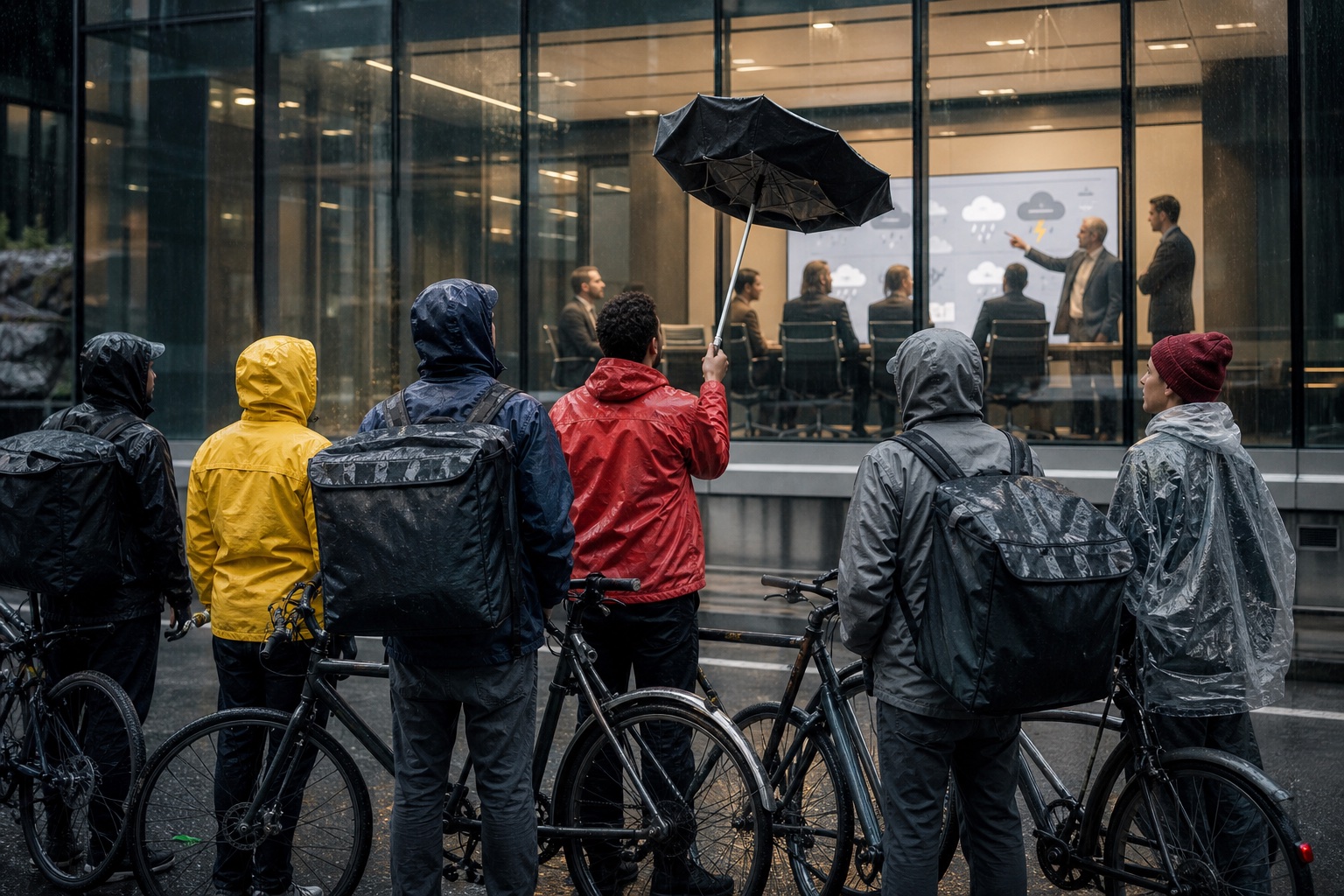
Food-delivery platform ZipDish announced Wednesday that its 180,000 couriers are no longer independent contractors but weather, a legal classification the company says more accurately reflects workers who appear outdoors, change without notice, and are blamed whenever dinner arrives late.
Under the new policy, couriers will be categorized as “localized logistics atmosphere,” allowing ZipDish to compensate them using a dynamic mixture of tips, surge icons, and the satisfaction of having moved through a city.
“Rain is not an employee. Wind does not clock in. A beautiful sunset has never asked us to reimburse a bicycle tire,” said chief legal officer Paige Loom. “Our couriers share these essential qualities, particularly after we removed the clock-in button.”
The app update replaces driver profiles with weather symbols. Experienced couriers are shown as partly cloudy, new couriers as morning fog, and anyone who rejects three consecutive $2 orders as a hazardous condition users may dismiss at their own risk.
ZipDish said the change will simplify earnings. Instead of hourly pay, couriers will receive “precipitation,” a proprietary unit that may be converted into money during periods of strong demand, sufficient investor confidence, and favorable barometric pressure.
Outside company headquarters, drivers gathered in heavy rain to announce the formation of the United Front of Atmospheric Labor. “If we're weather, this is a climate movement now,” said courier Imani Brooks. “And management should check the forecast.”
The company responded by adding a severe-weather surcharge to every order. None of the surcharge will go to the weather.
City regulators said they were reviewing whether a corporation may classify humans as meteorological events. ZipDish's attorneys expressed confidence, noting that existing labor law already permits several definitions with roughly the same relationship to reality.
At press time, the National Weather Service had issued a collective-bargaining watch for the downtown area, with a 90 percent chance of management calling it an isolated incident.